Author Archives: Barry Kelly

Barry Kelly's avatar

About Barry Kelly

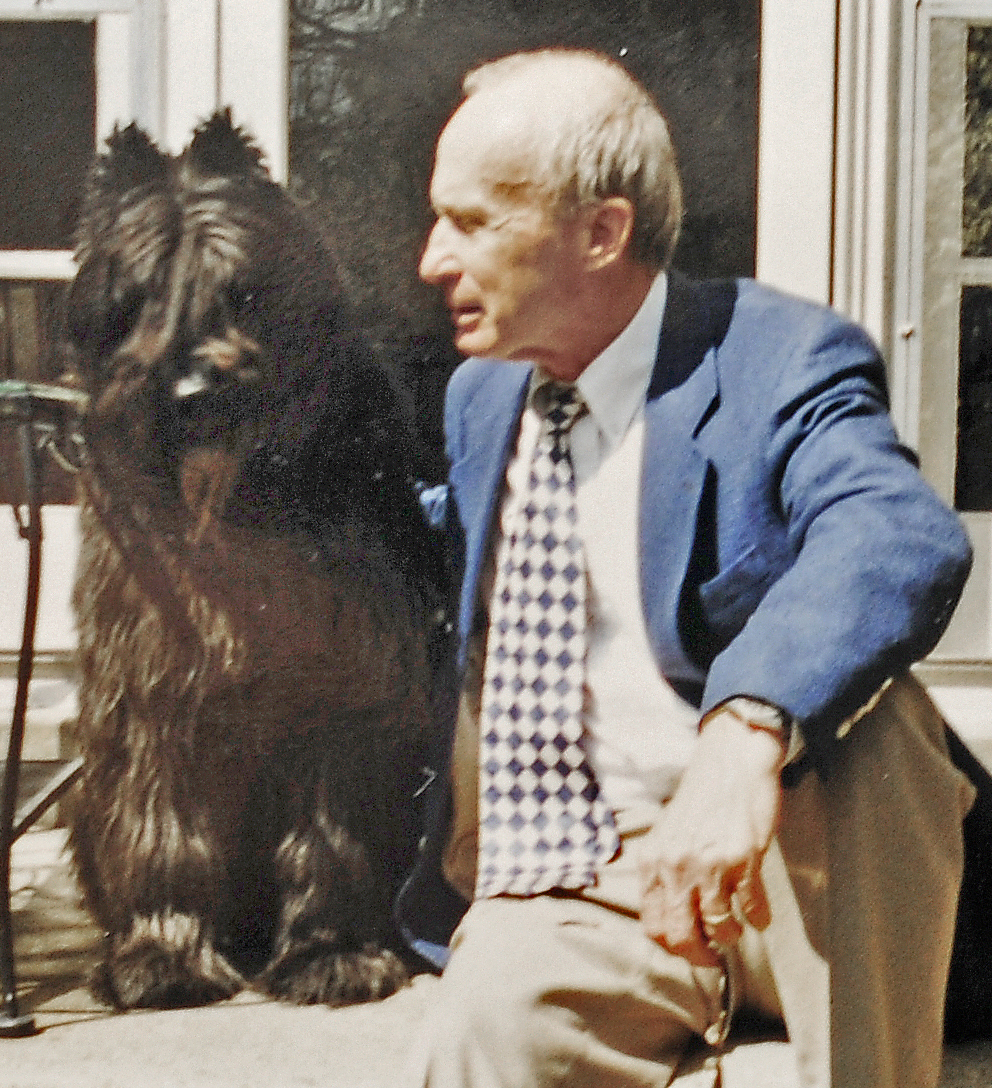
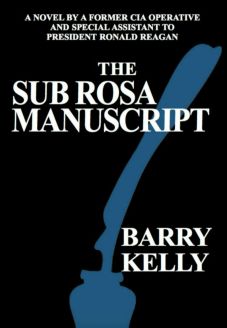
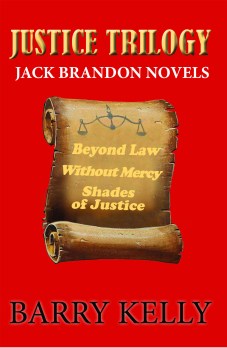
Author of "Justice Beyond Law," "Justice Without Mercy," "Shades of Justice," "Justice Without Mercy," and "Run to Freedom," as well as two ,"nonfiction books ,"INSIGHTS-The Transforming of America," and "INSIGHTS-Stepping Stones to Tyranny. He also is the author of the blog "8 Decades of Insights." Barry Kelly is no stranger to the world of espionage, counter-terrorism, weapons, deep cover, and the inner workings of the governmental security apparatus. His immersion in the Cold War began with enlistment in the U.S. Navy during the Korean War. Following his discharge, he earned a BA from the University of Pittsburgh and a master’s degree from Duke. His career in the CIA included deep cover operations and overseas experience, primarily in South and Southeast Asia. He has been awarded the Certificate of Merit with Distinction, the Intelligence Medal of Merit, the Cross of Gallantry with Silver Star, the Distinguished Intelligence Medal and the Intelligence Officer of the Year Award. After retiring from the CIA, Kelly served as a special assistant to President Reagan. He holds a first dan black belt in hap-ki-do. Visit www.factsandfictions.com or find the author on Facebook.

EIGHT DECADES OF INSIGHTS 66 ADVISOR

 IS IT TOO LATE?

Safe in the Shadows

Safe in the Shadows (Photo credit: sigma.)

The Advisor was slowly sipping his coffee as he waited for the President. The head of his secret service detail had called earlier and alerted the Advisor to a Presidential visit later in the night. It was now 10:17 P.M. Never mind the time he told himself if the President wants to come, he will come. Time makes no difference to me. This man is very hard to advise. I believe he has been that way all his life. He has a very inflated opinion of his capabilities. Not the first President to do so. He has never been held to any standard. Not as a child or as a student or even as a Senator. He does and says what he wants. Even contradicting his own recorded statements within days or weeks. I don’t think he even worries about consequences. Presidents have been impeached for less than he has already done.

Nixon left office before facing impeachment charges for a simple breaking and entering of a Democratic office in the Watergate. There was no proof that President Nixon ordered or knew about the break in before it happened. Nevertheless he deserved the threatened impeachment.  His closest advisors were involved and the President is responsible for the people he hires. President Obama after saying how serious the charges of the IRS discriminating against Conservative groups were, he is now calling it a phony scandal. Does he think Americans all suffer from short-term memory loss? He also has included the killing of Americans at Ben Ghazi a phony scandal. Same with the intercept of journalists phone calls and email.

Those are all very serious events. Far more deserving of Impeachment proceedings than WaterGate or sex in the Oval office. He is only saved by the weak Republican leadership of the House who act as if they are afraid to face facts. This President is hard to advise. I don’t know what to tell him today. We just don’t agree on a basic set of facts. He is the President and many of my predecessors have faced harder problems. I don’t want my President to be run out of office.

While the Advisor was worrying about what advice to give the President. President Obama arrived outside the steel door leading to the Advisor’s office. He stared at the antique copper plaque on the steel door and studied the faint inscription. EIGHT DECADES OF INSIGHTS.  Insights! What the hell am I doing here? The old black man inside is not helping me. Why does he think he’s so damn smart? I’m a Harvard graduate and a former professor. I think he knows what I’m trying to do but doesn’t let on. My legacy is not going to be like other Presidents. I don’t give a damn about solving problems or the ‘war on terror’ or creating jobs, or becoming a major producer of fossil fuel energy. I don’t even care about a health plan. What I care about is the redistribution of wealth and the destruction of this country’s power to create slavery abroad by dominating other nations, especially Islamic nations, through American economic and military power.

Only when the United States takes its place in a world wide family of nations as simply another member of the International Community will I be satisfied. We must follow the European model to provide for all citizens. Where everyone has equal opportunity and a fair shot and  a progressive elite manages the economy and directs progress. That’s my legacy. That’s what I want.  Real freedom for the middle class.

His Secret Service escort said, “Mr. President he can’t hear you through the door.”

“Too damn bad. I’m not completely nuts. No more of this.” With that outburst he spun on his heel strode back down the tunnel.

By the author of the Jack Brandon novels. http://www.factsandfictions.com

The author has 27 years of Government service, including two years serving President Ronald Reagan in the 1980s as an advisor. Considering today’s volatile political situation, you are encouraged to pass on this blog or parts of it to your contacts and friends. Comments and dialogue are welcome and helpful.
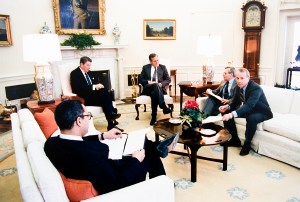
  • Meeting with President Reagan, Vice President Bush, Deputy National Security Adviser Frank Carlucci and General Colin Powell in the Oval Office.

3 Comments

Filed under Conservative views, Eight Decades of Insights, Intelligence & Politics

EIGHT DECADES OF INSIGHTS 65

Safe in the Shadows

LEADING FROM BEHIND–THE ADVISOR

The Advisor was thinking about how forceful he could be in advising President Obama. The subject for his next visit would be the consequences in foreign policy of leading from behind. The President wasn’t a stupid or a cruel man.   He was just a man who carried an enormous amount of baggage.

Could anyone walk away from the influences he was subject to in his earlier life? the advisor thought. Some he was personally responsible for, others he had no real choice. Parents from far to the left, several years in a Muslim Madrassi teaching Wahhabism. His father, an anti-colonialist Kenyan, whose family had been persecuted by the British Colonialists. For most of his formidable years he was exposed to radical leftist ideologies. Then, the influence of Ivy League progressives, Saul Alinsky and his radical plan for seizing power, Reverend Wright and his hate America sermons, William Ayers and his terrorist viewpoint and to top it off the ruthless and corrupt school of Chicago politics. The President never personally suffered from his associations and ideology. Therefore, he has no understanding of  the consequences of following a revolutionary ideology. It is probably too late now but I must try. I will never knowingly give him bad advice or try to manipulate him. My mission code does not allow it. After all, he was elected twice and could probably win a third term if it were permitted.

The advisor’s musing is interrupted when the flashing red light and soft chiming called him to the phone.

The President arrived a few minutes later at nine o’clock PM. The President strode into the room, greeted the advisor and said, “Let’s get started. I have some extra time and need a cup of your coffee.”

“Mr. President, you look like a man who doesn’t have a care in the world.”

“Today was good day. No one was asking me to do the impossible. Why do my supporters and staff think I should get involved in everything?”

“You are the ‘point of the spear.’ They count on you to give them what they want without understanding that doing nothing is also, at times, a good action plan. There, a perfect opening for my talk. Remember, you told me to pick the topic. So I’m going to talk about the concept of leading from behind. Please interrupt at any time. I’m going to use foreign affairs as a backdrop for my advice.

“You are in the fifth year of your Presidency. That is long enough for you to own America’s position in the world. You will not like some of my statements. But I will assure you, the the facts are correct. My analysis may be faulty because I project it into the future where no one can be absolutely sure they are right. First our main adversary, Russia. They are stronger now than they were before your election. Today their fleet is in the Mediterranean, something that was inconceivable in the last several decades. They have nearly secured a warm water port in the Med, a Russian goal going back to the czars. They failed in Afghanistan to find a corridor to warm water. Russia’s ability to project power has been limited for centuries because they lacked a port with year round operations capability. The Syrian port of Tartous is the payoff for their support to Assad. Sure, they enjoy threatening American and Israeli interests in the Middle East, but Tartous is the real goal.

“To see more clearly the Russian move into the Middle East, imagine a monopoly game where the winner gains areas of influence and the losers, well, lose. You failed to negotiate a status of forces agreement in Iraq where it was in no one’s interest for the U.S. to abandon the country. Certainly sectarian violence would be lessened if we had a seat at the table. Iran could not supply Syria forces through or over Iraq. Iran could not threaten Iraq if we had maintained a presence in Iraq. Iran would have a harder time supplying Hezbollah and using that force to control Lebanon, another possibility for Russia to exploit to acquire a warm water port. Our anti-ballistic missiles on the ground in Iraq could bring more defense against an Iranian attack on Israel or the Sunni Middle East. ‘Leading from Behind’ policies have resulted in our loss of space supremacy, ABM land-based systems, and talks about unilaterally cutting force size and our inventor of ballistic missiles that have kept us from a nuclear war since WWII.  Our loss of influence in Egypt, Libya, Iraq, and Pakistan is not a foreign affairs victory. Leading from behind means you are and will remain behind.

“Leading from behind does not win respect in the world. Your monopoly board does not look good. Putin has no respect for you as leader because he sees you weakening America and, therefore, believes you are not someone he should worry about. Most of the world respects power and distrusts weakness. To world leaders words don’t matter. Words without action are invisible. To start with I advise you to say less and do more. You can project American power without following the old colonial pattern you hate so much.”

The President puts his cup down, grinds out his cigarette.

The Advisor says, “Yes. I have known ever since you sent the bust of Winston Churchill back to England. Your constant concern is for the little nation, the poor people, the Muslim nations over the Colonial West. If you achieve your goal of leveling America and the world, you’ll destroy both and civilization of all will suffer. But that is for another time.”

The President gets up and strides to the door. He looks back as he leaves and says, “You can’t be right.”

The Advisor says, “Goodnight Mr.President,” to the sound of an automatic locking door.

He thought, that went well.


By the author of the Jack Brandon novels.   http://www.factsandfictions.com 

The author has 27 years of Government  service, including two years serving President Ronald Reagan in the 1980s as an advisor. Considering today’s volatile political situation, you are encouraged to pass on this blog or parts of it to your contacts and friends. Comments and dialogue are welcome and helpful.

  • Meeting with President Reagan, Vice President Bush, Deputy National Security Adviser Frank Carlucci and General Colin Powell in the Oval Office.

Leave a comment

Filed under Alinsky, Conservative views, Eight Decades of Insights, foreign policy, Intelligence & Politics, Israel, Obama, political solutions, Politics, Putin, Russia

EIGHT DECADES OF INSIGHTS 64 – THE ADVISOR

 Safe in the Shadows

The Advisor on Big Goverment                                    

“Good evening, Mr. President. Are you ready to hear my advice on the size and scope of government? Really, the same principles apply in some fashion to any very large organization. It’s not primarily dependent on which political party is in power. President Bush created the Department of Homeland Security and the Director of National Intelligence, against the advice of my predecessor, two of the worst examples of growing the size of government to fix some problems.

“Conservatives grow the government’s bureaucratic  forces to provide security. Liberals grow the bureaucracy to make things equal or to provide welfare services. Both are misguided. All bureaucracies  are created to regulate and control the actions of people who actually produce goods and services. These people are the ones who built this nation and who have created the most productive and free society the world has ever seen. They are the substantive force in our civilization. They care little for regulation that makes production more costly or inefficient. They rely on the forces of a free market to guide the economy. The regulators are the process people who do not have creative skills or the individual skills to build or manage but are driven to control the process which means to control the means of productions and distribution. It would be foolish to believe regulation is not needed at times but only in the smallest amount.

“Left to themselves, the regulators will centralize and grow the size of government to the point no business can function efficiently. Today we are close to that point where the founders and leaders of industry have to pay more attention to the impact of government  regulations and taxes than to the worldwide forces of the market place.

“The introduction was a bit long and you must want your cup filled and a cigarette. May I pour you some coffee? You’ll find your brand of cigarettes on the table. Any questions so far?”

” Yes, I’m ready, please pour. Although I’m beginning to doubt my sanity. I already think you must be a timeless relic from some faraway ancient civilization and wonder what beyond curiosity brings me back to your cave?  Do you ever leave here?”

“Mr. President, the first eight decades of my life were spent above ground. It is much easier underground. We all eventually get here. But we can’t spend too much time talking about me. My past years are of no significance. Advising the President of the United States is a full-time job, especially when we don’t agree on a common set of facts.”

“Second question. Yes. I’ve been here several times now and I still don’t know what I should call you.”

“You may call me anything. I am and have been many things. I’m old enough to have learned names and titles are of little importance compared to the impact a man or woman makes in improving and protecting our world.”

“Maybe I should call you a professor. You know I was one once.”

“Mr. President, I was once a professor but do not prefer that title and you shouldn’t, either.”

“Why not?”

“Well, to start with your academic grades are not good and you were an instructor, not an assistant professor, an associate professor nor a professor. Your current title far surpasses your academic credentials. But let’s get started before you get up and leave. Remember, down here we must have honesty. All pretensions and embellishments must be left at the door. You can pick them up when you leave.

“My worry  about big government is the embedded drive in humans to continue the process of centralization. Defined as combining segments of government, business, or religion into fewer and larger segments where fewer and fewer people make decisions. This process expands the scope of control beyond the ability of anyone to be an effective manager and steward of public funds. It is all part of the desire to make things better. Watch, when things go ‘wrong’ the cry is, ‘put someone in charge. Make someone responsible.’ 9/11 gave us that opportunity. Something was wrong. How else could such blow strike our homeland? A conservative government, under President Bush, moved to fix the problem by, of course, putting pieces of government together under a central control. To start with the pieces of government in their separateness, were not well managed. Many of them were already too large. Today Homeland Security is an example of centralizing management until you reach numbing inefficiency. Another example is the DNI organization. The Director of National Intelligence is about the worst fix anyone could have made to improve the collection, analysis, and dissemination of intelligence. I defy anyone to prove money is being saved or that the product produced has been improved. Top managers of such over-centralized organizations don’t have a clue to what is happening in the trenches. Their main concern is often getting enough reporting from the far reaches of their commands to make them look credible, especially when briefing the President or appearing before an aggressive group of journalists or legislators.

“Unfortunately, both our main political parties are vulnerable to the drive to fix things by centralization. National Health Care or Obamacare, Dodd-Frank, over reaches of OPA and the Department of Energy are other examples of good intentions leading to disastrous unforeseen consequences. While some centralization is necessary, decentralization is the sure path to renewed growth and vitality in both business and government. Good people in charge of manageable organizations can fix problems. Over centralization cannot. Creating a larger population of civil unionized workers is not a good thing even in the short run. To start with, U.S. Government employees should not be members of any union. Who or what does unionization protect them against? They are hired by the people, work for the people and are the people.

“You don’t need anymore union powers lobbying your presidency. Nearly every political  pundit comes to realize that the growth in government beyond that which is absolutely necessary, threatens individual freedom and the overall freedom to create and produce new goods and products. Look at all the cases in history where freedom has been lost or eroded by governments grown beyond the need. The growth of government is always pushed by people who have good intentions and a poor understanding of history and management principles.  Don’t let your presidency be the one that pushes growth of government beyond need and endangers freedom and economic growth.”

“I’m not sure I believe any of that but I will think on it.”

“Mr. President, thank you. You must make the final decisions. Not all advice is good. Maybe I am not 100% right all the time. But I have no personal or organizational agenda. What do want to cover at our next meeting?”

“You decide. I must go now. It’s a good thing you serve the best coffee and I have the freedom to smoke without anyone giving me disapproving looks. That alone makes me come back.”


The author of the Jack Brandon novels is a Korean War veteran and served in the Vietnam War as a CIA agent who has 27

Meeting with President Reagan, Vice President Bush, Deputy National Security Adviser Frank Carlucci and General Colin Powell in the Oval Office.

Meeting with President Reagan, Vice President Bush, Deputy National Security Adviser Frank Carlucci and General Colin Powell in the Oval Office.

 years of government service, including two years serving President Ronald Reagan in the 1980s as an advisor. Considering today’s volatile political situation, you are encouraged to pass on this blog or parts of it to your contacts and friends. Comments and dialogue are welcome and helpful. www.factsandfictions.com.

Related articles

Eight Decades of Insights 32 (factsandfictions.com)
The High Cost Of Maintaining ‘Homeland Security’ (warnewsupdates.blogspot.com)

2 Comments

Filed under Capitalism, centralization, Conservative views, Eight Decades of Insights, Intelligence & Politics, management theory, Politics, Progressives

EIGHT DECADES OF INSIGHTS 62 – THE ADVISOR

ADVICE ON BEN GHAZI

Safe in the Shadows

The last anxious White House staff member had just left the Oval Office. The President shook his head and mused. How did I ever agree to hire these frightened people? There is not a free thinker among them. If I had another election facing me, I’d call David and get rid of the entire bunch. Axelrod is the best strategist in my administration. We’ve made some mistakes. But I won the election. Without being able to delay and misdirect inquiries about Ben Ghazi, the IRS, the media outrage over phone tapping and NSA’s intercepting phone calls between citizens and their Internet activities, I might not be sitting here. There’s a lot of garbage I have to deal with but I like sitting here. Maybe it is time to make some cuts.

Eric Holder has lost his mind. I like the guy, but where is his common sense? Some cuts might buy some more time. Clapper should also go. How can the Director of National Intelligence be so dumb? God, I forgot about the press conference I agreed to tomorrow. I hate those damned things. They keep dredging up the past and ignore my push to kill the coal industry and focus on climate control. I can’t believe I want to see that old man in the underground office. He doesn’t mince words but he’s clearly giving me straight advice and there’s no danger of him leaking anything about our talks. I wish I could move him up here with me. 

Still muttering, the President rang for Chris Hammond, his Secret Service detail chief. Another person he trusted. He wanted Chris to take him down to the weird office in the tunnel to see the Advisor again.

Again the impeccably dressed old man met the President at the door. “Welcome, Mr. President. Is it too late for coffee?”

“It’s never too late for the coffee you serve. May I have a cigarette with it?”

“Yes, of course, this is after all an office established to serve you. In the past when government was much smaller, this office even took direct action outside to serve the President. It has been a while since that capability has been used. I think the last time was in the first few years of  Franklin Roosevelt’s last term. But you came here today about Ben Ghazi. How much time do you have?”

The President turned to Chris and said “Knock after 30 minutes.”

The old man escorted the President to the small table and poured coffee while the President lit a cigarette and sat back, exhaling. “You know I’m feeling relaxed here, even though I know I’m not going to like what you say.”

“Mr. President, I can not help you if I’m not truthful. It is not my mission to be critical, just to give you my best unbiased advice. I have no other agenda. Shall we begin?”

The President nodded. The Advisor said, “First let me state the common accepted facts.  Ben Ghazi was and is a dangerous place. Your Ambassador, the CIA, the Red Cross, the British, and almost everyone that knew anything about Ben Ghazi agreed it was a dangerous place with terrorist units growing in power. In particular, your State Department, counter to your Ambassador’s request, withdrew security forces from Libya resulting in a very reduced security situation. The Libyan situation on the ground was no threat to your re-election until your staff made it one. The American people do not expect miracles from their President. They do expect that what comes out of the White House has your approval and that they can trust the information. Shall I continue?” The President said, “Yes. That’s why I’m here. The coffee and the ability to get away from my own staff helps. I can’t say I like what I hear, but what you say has the ring of truth.”

The President lit another cigarette and refilled his cup, waiting for the Advisor to continue. The aroma of the rich black coffee and cigarette smoke filled the room. The President brought his focus back to the Advisor’s clear and measured voice and heard, “Your Defense Department contributed to the harm to your presidency. They had no agreed upon contingency plan to protect the people in Ben Ghazi. Nothing was in place ready to go on the Anniversary of 9/11. How dumb can they be? Their excuse is that there wasn’t enough time and too much confusion on the scene in Ben Ghazi. Both statements are false. No one knew how long the battle would last and there were drones over Ben Ghazi relying real-time information back to the Pentagon, the CIA, the State Department, and the White House Situation Room. In addition, two Navy seals with extensive combat experience and the ability to locate and illuminate mortar and machine gun positions and communicate the locations to the designated commands. I know something about combat from Korea and Vietnam. The tactical and strategic information in the hands of war fighters doesn’t get much more detailed or timely.

“Your Secretary of State and the timid commanders in your Defense Department let you down. My advice is to recognize this, get rid of the players who failed, and admit, in all the confusion, you sent your Ambassador to the UN out to provide a story that would cover the mistakes made by your Cabinet. Recognizing al-Qaeda still had teeth in Libya won’t harm you. Continuing to protect the incompetence around you will. The staff that produced the now famous ‘talking points’ must not have had your best interests at heart. You can end the damaging inquires and investigations by taking this advice. Your poll numbers will reflect the correctness of this approach. Lastly, note Saul Alinsky was never the President. His tactics may  have been helpful in getting elected, but you are now much wiser than he ever was about governing. When you are President every issue is the issue. His teaching that the issue is never the issue is only relevant to those trying to seize power. You have all the power you are ever going to have. The people judge their leaders exactly by how they handle issues. When you’re at bat, being called out on strikes doesn’t improve your image.”

The President stared at the Advisor, ground out his cigarette and said, “I must be nuts for coming here. I want to bring some of my key players down here to meet you.”

“That, Mr. President, is  something I can not do for you. You can bring any one you want here, but my protocol requires that I not be here and this office will be empty. The door you opened will not open if anyone is with you. Sorry but I must follow the rules laid down in President Lincoln’s time. What would you like to discuss next time?”

“Discuss is hardily the word. You do all the talking.”

“Not so. You do all the talking outside this room. If you don’t want my insights, just don’t come.  I can’t fix your staff. In fact no one can fix stupid, but you have the power to get rid of them.”

“If I come back I want your lecture on the NSA’s data mining program and later why you are afraid of a larger federal government.”

The Advisor walked the President to the door and opened it, saying, “I am always at your service.”

The author of the Jack Brandon novels is a Korean War veteran and served in the Vietnam War as a CIA agent who has 27 years of

Meeting with President Reagan, Vice President Bush, Deputy National Security Adviser Frank Carlucci and General Colin Powell in the Oval Office.

Meeting with President Reagan, Vice President Bush, Deputy National Security Adviser Frank Carlucci and General Colin Powell in the Oval Office.

government service, including two years serving President Ronald Reagan in the 1980s as an advisor. Considering today’s volatile political situation, you are encouraged to share this blog with others and to send your comments and opinions to the author. http://www.factsandfictions.com.

2 Comments

Filed under Intelligence & Politics

EIGHT DECADES OF INSIGHTS 61: The Advisor

THE PRESIDENT RETURNS

Safe in the Shadows

The President sat musing in the Oval Office. Nothing was going right. He hated to face the questions at the press conferences where all the reporters were trying to make their careers by destroying his. He picked up the phone  and signaled for Chris Hammond, one of the few people he could count on. Chris appeared within a few minutes and said, “Yes, Mr. President.”

The President said, “Chris, I need another cup of that Sumatra roast. Take me down to that basement office. I’m sure it would cause some commotion if I went down there alone.”

“You’ve got that right, Mr. President. If I don’t know where you are at all times, I’m toast.”

The second time Chris led him down to the tunnel and then to the hidden door with the cooper plate inscribed with faint cursive letters “Eight Decades of Insights” didn’t seem to take so long. It was good to get out of the Oval Office where everyone is always clamoring to see me, the President thought. Why don’t they all just do their jobs? He put his right palm on the plaque and the door opened. The well-dressed elderly black man met him as soon as he stepped inside and led the President to the same small table with the coffee service. He poured coffee for the President and asked him, “How much time do you have?”

“Let’s plan on half an hour,” said the President, taking a deep smell of the hot coffee. He took a sip and settled into the chair.

“You know, Mr. President, you don’t have come down here in the middle of a busy day,” said the Advisor, watching him. “You may come at anytime, day or night. If you believe we are through with a subject or you’ve heard enough, just tell me. I’ll start with the IRS issue. I believe it is the most important one facing you now.”

“I’m listening.” The President held his coffee cup and sat back in his chair.

“Issues are seldom isolated from other problems. The IRS issue is tied up with Obamacare and the economic status. No one likes the IRS to start with. It has always pushed the fringes of the public’s sensitivity over their privacy. Without exception it is the most un-liked and feared part of any administration. My advice is for you to take the IRS out of your centerpiece health care legislation. Create a new organization to administer health care. Reduce the size of the IRS to cover or mostly cover the growth of a new executive organization. Delegate as much of the administration of Obamacare as you can to  the states. Make this a major speech. Americans know their health care needs fixing. Tell them you realize Obamacare is not perfect but it is a good starting point and you are willing to give it another look. With the passing of time you recognized some elements may need to be modified. Those points will buy you a lot of good will and approval points.” The Advisor paused to let his advice sink in. The President said nothing, so he continued.

“Now you are free to cut those of your staff who knew about the IRS targeting of conservative groups and all the IRS employees engaged in the targeting. Get them all out of your administration. If Congress wants to continue with their investigations, let them. Cooperate as much as you can. If some IRS staff end up in prison, so be it. They knew what they were doing was wrong and that their actions endangered the President. They, like all of us, must take responsibility for our actions.

“Anyone who reads your speeches knows you are pushing a progressive political philosophy that, in your own words, will ‘transform America.’ Americans understand your political objective. They don’t understand the constant shifting of your position on issues. Saul Alinsky may have taught all his students that the issue is never the issue and that you can be on any side of any issue and change sides according to the way the issue can be used to destroy opposition, but the real world doesn’t give presidents or political leaders that freedom. Keeping your word and explaining changes in your position is more important. If the people lose trust in your word, your presidency is over. You must clearly understand that campaigning is not the same as governing. The latter requires compromises and cooperation both in content and form.”

There was a knock on the door and when the Advisor opened it, Chris said, “Mr. President, the half-hour is up. Do you want me to change your schedule?”

“No, Chris, I have to go. Half an hour of straight talk is enough for right now. Set me up for another visit Sunday night.”

The President turned to the Advisor and said, “You are certainly no ‘yes man.’ I’m not sure I agree with you, but thanks.”

The Advisor walked the President the few steps to the door. “I assume you still want me to discuss Ben Ghazi with you on your next visit.”

The President nodded as the thick door closed and he had to return to both the trivia and substance of the Oval Office.

By the author of Jack Brandon novels.          www.factsandfictions.com    Any parts or the entire blog may be passed on.


2 Comments

Filed under Intelligence & Politics