My motivation in starting this blog was to publicize my novels. Along the way I couldn’t resist discussing other topics. But this blog, 11, is dedicated to fiction that carries several messages.
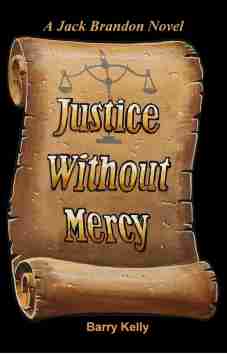
The first novel was titled JUSTICE BEYOND LAW. My second novel is called JUSTICE WITHOUT MERCY. Both are thrillers about a group of people who take extreme measures to combat terrorism with little regard for political correctness. JUSTICE WITHOUT MERCY will be available worldwide in a few weeks. Both books are or will be available at Amazon and Barnes and Noble in both print and as ebooks using Kindle and the Nook. Several professionals with military or intelligence backgrounds have given me a thumbs up. Below is the prologue for my second novel.
JUSTICE WITHOUT MERCY ©
ANOTHER JACK BRANDON THRILLER
By Barry Kelly
PROLOGUE
Five years ago Joel Hankins, known in the camps as Mohammed Abu Moussa, finished his training at the camp for foreign fighters in Afghanistan. He learned to handle most small arms and explosives but was near the bottom of his trainee group of twenty. His strength and toughness were not equal to the rest of the trainees. The camp was above nine thousand feet with very little vegetation. They lived in caves and were never really warm at night in the winter months. The people they lived among were incredibly poor. Every disease in the mountains of South Asia was visible in the small village near the training site. Even so, his experience at that camp was the highlight of his life. He was someone, someone special. He wasn’t the loser everyone said he was in Pittsburgh. He had even met Usama Bin Laden.
Just before he left the camp his leaders told him that they had been searching for months to find a westerner of the true faith to help carry Jihad to America. Joel wasn’t sure of the true faith, but he did pray at least twice a day and spent another hour each day reading the Koran. He had grown comfortable with the teachings of the Prophet and was proud to be a part of the holy war to establish a Muslim Empire that someday would include the United States.
His leaders knew they were not strong enough to have their own sovereign nation in the face of the forces aligned against them. Control of territory was necessary to recruit and train followers. In Joel’s training group there had been students from Saudi Arabia, Jordan, Iraq, Palestine, Egypt, Pakistan, Indonesia and several western nations. If the Taliban could not hold Afghanistan, where could the faithful train and plan damaging attacks against the infidel nations? Joel was happy he had been assigned to help locate a place within the United States where faithful Jihadists could find safe haven.
Before he left Afghanistan, he was taken to a compound in Peshawar and left in the care of a Palestinian trainer. This man was an expert with real experience in clandestine operations. The trainer told Joel that in the next three weeks he had to be ready for his assignment in America. He was told to forget his Muslim name. While he was in America his name would be his own, Joel Hankins from Pittsburgh, PA. When his training was over, he would return to Pittsburgh and tell his family he was done traveling around the world and wanted to prepare himself for a career in business. At first Joel objected to this plan but his mentor, a powerful man with intense dark eyes, told him there was no room for dissent. He had been chosen and he would follow orders, or he would never leave the compound alive.
Joel never doubted that Hakim meant every word he said. Putting on his most respectful look, Joel said he would obey and carry out any mission assigned to him. During the next three weeks, Joel was given intensive instruction in the methods of planning, supporting and carrying out terrorist activities in the United States. He had always been good at detail, and soon reached a level of competence that surprised Hakim. In the last week, Joel learned how to deal with hostile interrogations and to prepare cover stories for everything associated with terrorist operations. His first mission was to establish a rug merchant shop in Charleston, SC. The necessary money would be deposited in his name in a Charleston bank.
After Joel satisfied Hakim with his ability to use the tradecraft of espionage, he was delivered to a Taliban supporter in Peshawar who operated a rug manufacturing and export business. Another two months were spent learning how to appraise and sell rugs. From time to time, Hakim would drop by and give Joel a mission to accomplish. Joel never knew whether the mission was for real or practice.
When Joel left Peshawar, he had lost all the trappings of a devoted Jihadist. His thin blond hair was cut short in the style of young Western businessmen. His beard was gone and his new clothes tailored to his scrawny build. With his light blue eyes, wind-burned acne face and wearing his first tailored suit, he was ready to return to Pittsburgh where he had a personal mission and then on to Charleston. His long stay in Pakistan was covered by his learning the art of dealing in Oriental rugs. A hundred rugs were sent in his name to a holding address in Charleston as further evidence of his status as a rug dealer.
It had been two years since Joel left Pittsburgh for Pakistan and Afghanistan. Getting off the Greyhound bus at the downtown terminal on a sunny October day, Joel decided he wasn’t going home. His mother died while he was with the Taliban. He hated his father and only wanted to see him one more time, to kill him. Killing didn’t require any talk. Joel also had a mental list of girls he knew in Schenley High School whovhad laughed at his advances and talked about him behind his back. Shirley Bronson and Sally Hartley were the worst. Joel planned to look them up and see if they could still laugh when he was finished with them. His growing lust to kill young women was one thing he had never disclosed to his Muslim contacts. Now that he had the killing skills and the training to avoid being caught, he was ready to start.
Joel took a local bus out to a poorer section of Oakland and paid cash for a room at a rundown boarding house. No questions asked. Just cash in advance. Two days later he paid cash for a high-mileage 2000 model Dodge van. He wouldn’t kill his no-account father on this trip. No sense in giving the cops something to work on by getting the Hankins’ name involved. Four days later, he had killed both girls.
It was easy. They were both students at Pitt and lived at home with their parents. In two days he had their after-school schedules down pat. Both worked in the University’s library week nights and walked home together just after ten o’clock. His first try failed. Too many bystanders were close to his selected ambush site. He had learned patience. The next day Joel parked his dark blue van at another site along their route home. When the girls passed his parked Dodge van laughing and talking, Joel slipped out of the shadows behind them and slammed their heads together. Holding them up, he used his remote to open the side door and shoved the stunned girls inside. There were no lights on in the van. Pulling the right fuses had fixed that. In the darkness after gagging them, he put cloth bags over their heads and duct taped their hands and legs.
Just before midnight, Joel dumped their naked bodies in a wooded area of Schenley Park. He kept their clothes. Along with the photos he took while torturing them, he had a good start on his collection. With both girls his clumsiness caused him to miss the moment of death. The next time he would do better.
Early the next morning he got in his van and left for Charleston. He loved the news coverage. The killings made the front pages of the Pittsburgh papers and the evening news on the networks. With his new knowledge and training, it was easy to outwit the police. There was no evidence he had returned to Pittsburgh, and he left no evidence behind. Those feel-good murders were his business. His al Qaeda leaders didn’t need to know.
Two years later, Joel’s rug shop in Charleston was making a little money. He had found an ideal place for the shop in a rundown building on the western end of Meeting Street. It had an apartment above the shop and a two-story, three-car garage in the back with space on the second level for two bedrooms, a bath and kitchen with a small sitting area. It was enough to house four or five people for short periods.
Three or four times a year, an al Qaeda courier stopped in his shop to deliver instructions and wait for Joel to write a response. He had no electronic communications with al Qaeda. They used a simple code based on a particular edition of the King James version of the Bible.
Life was good. Joel continued the training regime he learned in the camps and joined a shooting club. At least twice a week, he took private Taekwondo lessons. Within a few months he would test for his blue belt. He was no longer the scrawny kid that left Peshawar two and a half years ago.
Joel made time for his passion for thrill killing, but he never killed in Charleston. His training had taught him the importance of patience and attention to detail. He set no pattern in his kills, except that his victims were all attractive young girls. No weapons were used to kill them. Joel never killed in any city more than once a year. He was addicted to the feeling of power he got from killing. He would take his prey his own way while he was young and alive. There was no rush like watching the light fade in his victims’ eyes. No one would ever have these bitches. In a few cases he had been lucky enough to catch the moment with his digital camera. Too bad he had to keep the images hidden. Rug business trips provided all the cover he needed for visiting other cities. The urges were becoming stronger. It was about time that he made a hunting trip to Myrtle Beach.
LIES ARE A TRAP, NOT A DECEPTION
bk
Share this with your friends:







 Barry Kelly | Facts and Fictions