Tag Archives: President Obama

INSIGHTS 202 — THE ADVISOR AND WHAT’S WITH THE IRAN THING?

Advisor's vault door


The Advisor had worked all week in getting ready for tonight’s discussions with the president. There was a lot to cover.

The entire negotiation process with Iran was filled with false starts, new beginnings, and endless private discussions by various participants.This was going to be a hard session. The Advisor had serious reservations about negotiating with Iran, but he knew the president was dead set on doing some kind of a deal with Iran. But the president had told him he wanted to hear his candid appraisal of the Iran initiative.

A soft bell rang and the Advisor glanced at his hall monitor screen. Sure enough the President and Chris were on their way to the old iron door to his chambers and only 25 minutes late. The president gave his usual murmured greeting and sat down at the conference table in his usual seat. The Advisor poured him a cup of fresh cup of dark roast while the president was lighting a cigarette.

“I know I’m not going to like what you’re going to tell me, but you’re the smartest person I get advice from and you don’t have an agenda. Of all the things I’ve told you over the years, nothing has leaked. You and I have opposing political beliefs but no one hears them except me.”

The Advisor thought, No one hears them but my successors for as long as this nation endures will be  able to read them. The president nodded and said, I’ve got 45 minutes, so let’s get started.”

“Mr. President, the Iranians or Persians are a great and proud people. They’ve slipped over the centuries from the pinnacle of being a dominant world power. They want to reclaim their heritage. They don’t have the population or the economic base to be even a regional power. They have correctly analyzed their position and have concluded that becoming a nuclear power is the quickest way to improve their status. Under their religious leadership they will not be redirected. No matter the price, they will pay it. Keeping economic sanctions on will only delay their journey to nuclear status.

“Nothing they say or promise will change their push for nuclear weapons. So you cannot trust them to keep their word. Short of changing the Iranian leadership or very heavy military strikes at their nuclear facilities and military centers nothing you or others can do will stop Iran from becoming a nuclear power.

“Now for the downside of negotiating with the Iranian leadership. You know better than your White House staff, the political ramifications of the Sunni/Shiite division. Our traditional Middle Eastern allies have been the Sunnis. Our dealings with the Iranians have driven a stake of mistrust between us and the Sunnis that may never be removed. In addition, the Israelis believe America has deceived them. Their trust in America has been seriously eroded.

“The other downside of a deal with the Iranians is that until now we have successfully kept the Russians out of the Middle East. You have already seen the Russians move to sell first line air defense hardware to Iran. More weapon sales will follow. Your European friends will not agree to reimpose economic sanctions. They want Iranian treasure for their goods more than they worry about Iran becoming a nuclear power. They have always been appeasers when faced with a choice between future dangers and the promise of prosperity now.

“One last point. when Iranians get the bomb, they will use it. My time is up.”

“Good. I’ll tell you now, while I agree to some of  your analysis, I do not agree with your overall conclusions. My plan is to use Iran to change the world order in a way that will ensure a more peaceful world based on a partnership between nations in a playing field I have leveled. At our next meeting, it will be my turn to talk.”

The president ground out his last cigarette and left.

The above is a fictional account of a president meeting with a legendary but fictional advisor.

 “ISIS Quiet Justice,” a new Jack Brandon novel dealing with ISIS in America, is now available from Amazon and Barnes and Noble in print form and nook and kindle formats. Follow the author on Twitter @factsfictions80.
1 Comment

Filed under Eight Decades of Insights, Intelligence & Politics, Iran, Israel, political solutions, Russia, Shiite, Sunni

INSIGHTS 201 — THE RETURN OF THE ADVISOR

Advisor's vault door

A few years ago I enlisted the aid of a fictional person I called the Advisor, to help me chronicle President Obama’s transformation of America. The resulting blogs were, of course, fictional, but I do think they added a dimension of clarity to my musing and scribbling about the exploits of this incredible period of our history. And besides, they were fun to write. As readers of my Jack Brandon novels know, I’m a storyteller.

First, the setting of the stage:

– – – – – –

Fighting loneliness in his subterranean office suite was the Advisor’s hardest problem. When he was approached a few years ago by the Keepers of the Book to become the next secret presidential advisor, he had had no idea how hard it would be to maintain perspective without face-to-face human contact. After his wife died, the Advisor had moved to an isolated cabin in the Blue Ridge Mountains where he could write and think in peace and quiet. When the Keepers of the Book approached him, he had thought “How hard could it be to go from my ridge-line cabin to an underground existence? “Turns out it was very hard. He even looked forward to the twice a month delivery of food and supplies even though no conversation was permitted.

Through the history of this small office each incumbent advisor picks his successor. The successor takes over only on the death or incapacity of the incumbent. There is no training. The advisor is picked solely because of his experience and service. Also they must be at least 80 years of age. In reading of the Advisor Journals from pre-Civil War times to the present, he could sense the isolation and loneliness that plagued his predecessors. He searched the journals for ways to cope but found none, only just to endure day by day. The Advisor realized his loneliness and isolation wasn’t much different than that which presidents endured. They, at least, had that in common.

Part way through his first term during a period when nothing was going right or fast enough, the president thought back to his brief meeting with his predecessor just after he was sworn in.  He called in the head of his Secret Service detail for a private talk. When Chris Hammond showed up a few minutes later, the president said, “Chris, sit down and have a cup of coffee with me. You remember the last meeting I had with George Bush before I was sworn in?”

“Yes, Mr. President, I do.”

“You were there. Tell me what you heard him say.”

“President Bush said when he had his last talk with President Clinton, President Clinton told him that when he really needed advice from someone whose only agenda was to serve the president and protect the nation there was only one place to go for advice. Presidents starting with Lincoln had gone there for advice.”

“Can you take me there now?”

“Yes, Mr. President. Give me just a few minutes.” Chris searched his phone’s memory, selected an obscure number and said, “Sir, I’m bringing the president down now,” and ended the call.

Chris led the president down into the tunnel running from the White House to the Treasury Department. He stopped at door that said “NO ADMITTANCE” by order of the Secret Service. Chris swiped his card and at the faint click pushed the door open for the president. They were now in a dimly lit passage. Chris stopped at the second door. The president studied the faint copper plate on the door. He could barely make out the words. Chris said, Mr. President, “I’ve been told that copper sign has been in use since President Lincoln’s time.” The words said “Eight Decades of Insights.” Chris said, “Mr. President, put your right palm in the center of the sign.” He did and the door swung open into a small, modestly furnished room. An elderly black man was sitting behind a desk, the wall behind him was covered with full bookshelves. The old man, in a very well-tailored suit, got up and extended his hand to the president, saying, “Mr. President, welcome. Please have a seat. I’ve just brewed some fresh Sumatra Roast coffee.”

The Advisor, looking like a clothing store ad with his stark white shirt and charcoal suit, red tie, and gleaming black shoes led the President over to the small conference table.

The president asked, “Who are you?”

“You can know my name but it is not important. I’m merely one in a long unbroken line of men and women who have occupied this room waiting to serve the man sitting in the Oval Office.”

“How can I trust your advice if I know nothing about you?”

“Mr. President, it is your decision. I’m only here to respond to your questions. Some presidents have used us, others not so much.”

“What do you know about me? Living in this subterranean room is not a very impressive setting for a presidential advisor.”

“I’ve read all your speeches and watched you deliver many of them, actually too many. I have your records as a senator, both of the United States and Illinois, as well as all your academic records and papers. I know about the development of your progressive ideology and the influential people in your growth, such as Saul Alinsky, Reverend Wright, and others we both know from your early life. I have access to the Internet, including many databases. Some restricted. Mr. President, the person sitting behind this door waiting to help does not approve or disapprove of the president or his agenda. We are only here to help you govern and protect the United States. Now how may I help you?”

– – – – – –  

Now the stage is set. On his next visit, the Advisor will go over the President’s relationship with Iran.

“ISIS Quiet Justice,” a new Jack Brandon novel dealing with ISIS in America, is now available from Amazon and Barnes and Noble in print form and nook and kindle formats. Follow the author on Twitter @factsfictions80.

Leave a comment

Filed under Intelligence & Politics

INSIGHTS 167 — CONSERVATIVE VIEWS

How far apart are conservatives’ and liberals’ political beliefs? Can the two ideologies ever work together to run the country and produce bi-partisan legislation?

The core values of the liberals and conservative values are made up of a mixture of myths, traditions, interpretations of the Constitution, and views ingrained in respective cultural exposures.  The respective core values of liberals and conservatives are not easily put aside. Thirty or forty years ago, I wouldn’t have thought the dividing line was so hard to cross. After all, I was once a strong Democrat, a member of the NAACP, and suspicious of capitalism.

Now that President Obama has succeeded in dividing the people into two angry camps with his income distribution, class warfare, and anti-business rhetoric, the nation is more divided than at anytime since the War for Independence and the Civil War when families, towns, and states were divided into Tories or revolutionaries, slavery or non-slavery states, and unionists or secessionists.

President Obama and his progressive party have helped me understand how members of the same family could pick up arms against each other and fight to the death. People only reach those extremes when their core beliefs are threatened. For people to feel so strongly, they have to believe their nation, way of life, freedoms, and futures will be destroyed if the opponent wins. As a conservative, I believe we are approaching that point. Two more terms of the progressive party would continue the breakdown of constitutional barriers, our two-party system, individual freedom, our national security, and national sovereignty and would certainly destroy the America I know and love.

What are the conservative core values? The starting point is that conservatives mistrust government and believe the bigger the government becomes the more it is distrusted. Why? Because it is only the government that can take away our individual and collective freedoms.

A federal government is necessary, but the difference between liberals and conservatives is how big the government should be and what it should do. Conservatives believe that the federal government should only do what the states or people (the public sector) cannot. The job of our representatives is to constantly adjust the size and scope of government to protect rather than diminish freedom. This historic distrust of government is what fathered the Second Amendment guaranteeing the people’s right to bear arms. The best explanation of this right, to me, is that slave owners had guns, slaves did not. Every totalitarian government has always taken weapons away from the people. Anyone wonder why?

Conservatives believe capitalism is the only economic system that allows people to establish and run commercial enterprises that provides growth to the national economy and jobs for the nation’s workers without endangering individual freedoms as a socialist- or communist-managed economy always has. Capitalism is not a perfect system and it needs some regulation but it is the only economic system that meshes with the power of the free market.

Another core conservative belief is that individuals are better stewards of their money than the government. Therefore, taxes should be as low as possible. Low taxes enable more savings and spending by people that feeds the growth of the economy. Everyone with an income should pay some income tax. Higher taxes on the rich are acceptable as long as they are fair and far short of confiscatory. Death taxes are unacceptable. They are clearly part of a redistribution of wealth program. No card-carrying conservative believes a government can spend its way out of a depression or recession. Government spending does not create wealth. Also, no corporation is too big to fail. Government bailouts waste the nation’s wealth.

Welfare for those who need assistance such as the very young, disabled, aged is necessary. Social Security, a program fought by conservatives during FDR’s tenure, has turned out to be a good program. It needs to be made solvent by some simple changes. In FDR’s time, 65 was old. No more. The age of qualifying for social security needs to be gradually increased. Again, that is the kind of thing our representatives are sent to Washington to work out.

Conservatives believe in a strong national defense and distrust any move toward giving any part of our sovereignty to any international organization.

For most of our brief history we have managed to govern by parties with different core beliefs working together for the good of the people. I believe we can get back there. My personal belief is that term limits on our senators and representatives would make all this much easier. Professional politicians, regardless of party affiliation, are too engrossed in their own careers and re-election politics at the expense of the nation.

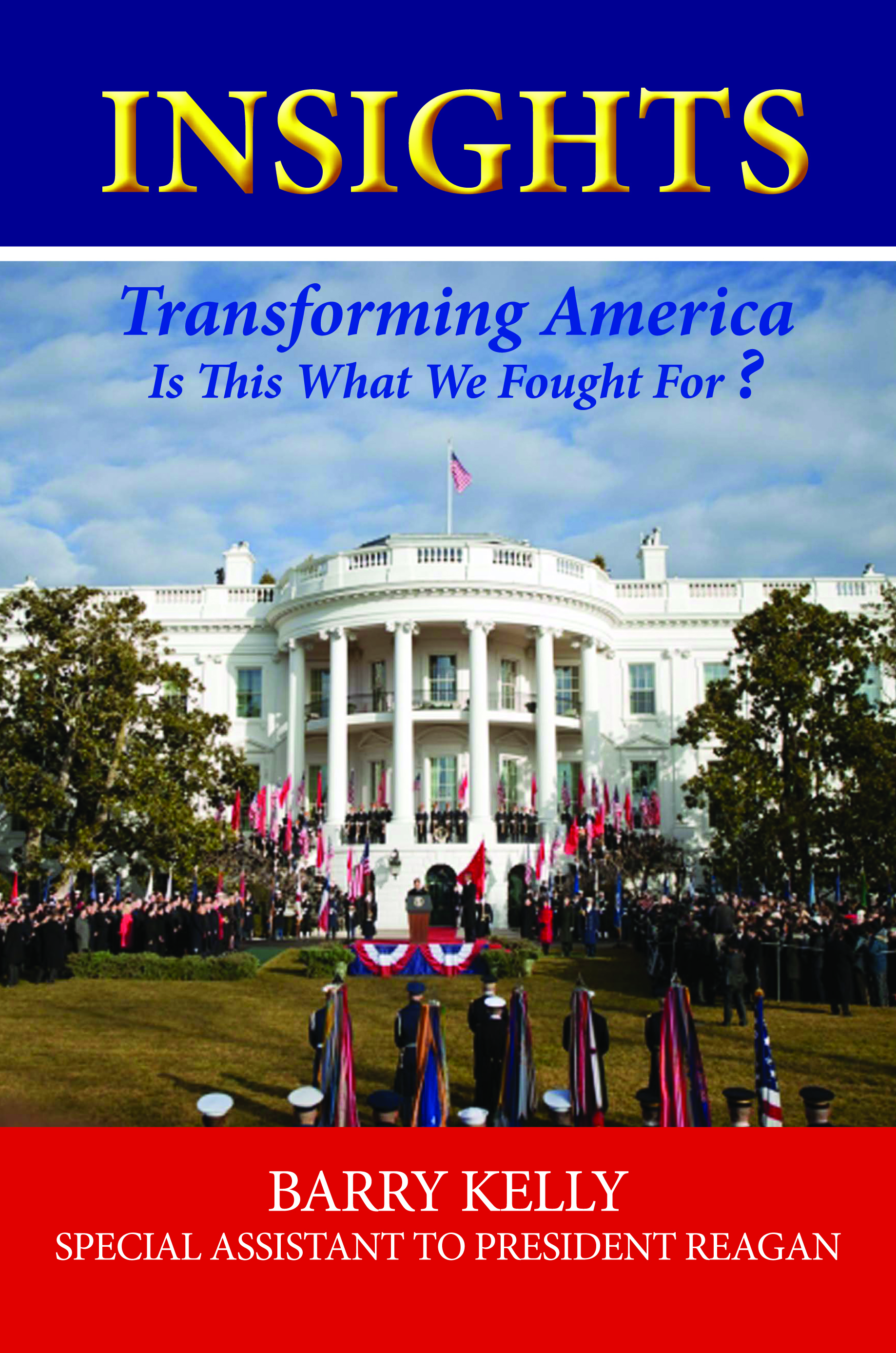
 Written by the author of “Insights: Transforming America — Is This What We Fought For?” available now as an ebook, in paperback or hardcover on Amazon.com or BN.com. Follow the author on Twitter @factsfictions80. If you think this message is important, please share it.

 

Leave a comment

Filed under Barry Kelly, Capitalism, class warfare, Conservative views, political solutions, Politics, Progressives, totalitarianism

INSIGHTS 166: UNDERSTANDING THE RELIGION

To understand your opponent’s beliefs, you need to take the time to identify their core beliefs. Today, I’ll look at what I believe are the core beliefs of those who are left of center along the political divide.

All of us must recognize that the core beliefs of political parties, religions, social groups, and even sports teams have beliefs that are a mixture of facts, myths, tradition, and emotional ‘need-to-believe’ items. I believe the core values or beliefs of liberals start with the tenet that capitalism is essentially evil and it needs constant and extensive regulation to mitigate the damage that it does. Certainly the liberal/progressives working in the Obama administration have pumped out thousands of regulations that affect commercial activities of corporations and small businesses. For everyone to ‘have a fair shot’ like the liberals want, they believe capitalism must be drastically controlled.

The pay gap between CEOs and workers must be reduced. Liberals believe in deficit financing because it is necessary to fund welfare programs and other important government spending. Keynesian monetary policies, based on the belief that a nation can spend its way to prosperity, are a mainstay of liberal economics. This theory was extensively tried during FDR’s terms. FDR’s Secretary of the Treasury Henry Morgenthau, Jr. finally convinced his boss that deficit financing was not working. Nevertheless, ‘spending to prosperity’ is still a core liberal/progressive belief.

The liberal core belief on tax policy is that taxes on the rich and corporations should be high enough to fund extensive welfare programs. They are not concerned about the number of people on welfare. A high percentage of the population on welfare and paying no income taxes is a good thing. The government is doing the right thing when it takes care of people by welfare programs. This belief does not make the connection between high taxes on the rich and corporations and the failure of the economy to grow and produce jobs. Tax policy is a primary tool to income redistribution. Interestingly enough, liberals never point out the high salaries being paid to Hollywood and sports figures. They receive their wealth because they earn it when the rest of us are willing to pay for the products they produce. This is capitalism but it doesn’t apply to other commercial ventures.

The necessity for big government with increased centralization of government is another core belief of liberals. To manage education, commerce, welfare, law enforcement, health care, communications, and tax collection, a large centralized federal government is necessary. Liberals believe big government is not a bad thing for it protects and enhances freedom and individual choice.

The ‘big government is good’ belief does not extend to the Department of Defense. Nearly all liberals believe the defense budget should be cut and the savings allocated to welfare programs. Sounds good, but the basic responsibility of the government is to protect the people. The connection between cutting defense and reducing the ability of the government to defend us is not made. Even today President Obama is moving forward with his goal of cutting the armed forces back to pre-WWII levels.

Liberals/progressives believe that a small elite group of liberals can better manage the government than the free-for-all political system set up by the Constitution and years of tradition. This is why the liberal media and universities do not do their job of keeping government honest. Our founders knew liberty requires eternal vigilance. This belief is not part of the core beliefs held by the liberal/progressive elite in America.

Perhaps the biggest plank in the liberal platform is a deep guilt about  American wealth and power. Why else would students studying at Harvard, recently vote that America is a bigger threat to world peace than ISIS? My worry is that by the time these smart wonderful kids learn the truth about their country and the world, it will be too late for them and the rest of us.

Written by the author of “Insights: Transforming America — Is This What We Fought For?” available now as an ebook, in paperback or hardcover on Amazon.com or BN.com. Follow the author on Twitter @factsfictions80. If you think this message is important, please share it.

Leave a comment

Filed under Capitalism, centralization, class warfare, Conservative views, Eight Decades of Insights, Intelligence & Politics, Politics, Progressives

EIGHT DECADES OF INSIGHTS 152

InsightsFor the next few blogs I’m going to publish excerpts from my book, “INSIGHTS: Transforming America — Is this what we fought for?” This book is now out in paperback and on Kindle or Nook. I’ve kept the price low because I want this message to get to as many people as possible. Please pass these blogs on to your friends and contacts. For those of you who have read my book, you needn’t read again the same words but please pass them on. I’ll respond to as many comments and questions as I can. If you’ve had difficulty understanding this president, reading “INSIGHTS” will help you understand Obama and explain what is happening to your family and friends, conservatives or not.

WHY DOESN’T HE GOVERN?


The president’s devotion to socialism and the teachings of Saul Alinsky prevent him from working to solve important national and international issues. President Obama can only see issues as opportunities to be used to destroy his opposition. The destruction of the opposition clears the way for the building of a one-party government with an equal opportunity society where wealth is distributed by a centralized government, just like Alinsky preaches in his book, Rules for Radicals.

Alinsky is a brilliant revolutionary, but he was never president. His teaching may have guided Obama to the presidency but surely does not help him govern where issues are real. If you don’t solve them, you are held accountable. Cute messaging and flip-flopping on nearly every issue — such as raising the debt, setting red lines, refusing to recognize the nation is at war with terrorism, or that the economy is in bad shape — are hurting the president’s ability to govern.

Recall his vote against raising the debt during President Bush’s tenure because he thought raising the debt ceiling was being unpatriotic.  Inconsistency and the loss of respect for your word diminishes any leader. This president just doesn’t seem to understand that historical lesson. 
He doesn’t care about how the Affordable Care Act affects the people as long as it puts seven percent of the economy under government control. Nor does he worry about the number of people out of work, the insecure national borders, foreign affairs, nor the increasing cost of welfare.

All these issues bring more people under the care of the central government. To maintain the momentum of people coming under government care he must keep spending beyond the nation’s income. An economic crisis will enable him to nationalize more of the economy. His plan won’t work in the long run but it will cause great damage to the nation and the American safe harbor for individual freedom, which is the hope and bedrock for a free people everywhere.

Leave a comment

Filed under Alinsky, Barry Kelly, Books, Conservative views, Eight Decades of Insights, Intelligence & Politics